It's been so cool to have time this year to read. As my 'opie' says, I have "an eye for the printed page", and although not entirely sure how deep the meaning of his short quote means to go, I certainly do love to read. I just wanted to take the time to mention a few of the accomplishments in reading I've made this year.
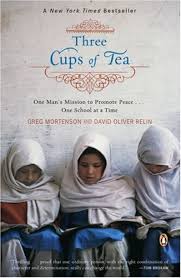
One of those, a book I finished yesterday, is called 'Three Cups of Tea' (picture above). My mom gave it to me for Christmas, but I finally had the chance to pick it up, and reluctantly put down. I reccomend the book (for book groups, to donate to the library, as history . . . whatever), because it gave me such inspiration to make a difference, and background about the Middle East. The book is about a man named Greg Mortenson, who, after a failed attempt at climbing K2, stumbles across a village and sees the hardworking students practicing time tables with sticks in the dirt. His mission to build schools in Pakistan (and eventually in Afghanistan . . . during 9/11) eventually helps him and a founder form the CAI -Central Asia Institute. The organization is still trying to 'promote peace - or help prevent fighting in the war on terror' through education, especially for girls. I just thought the modern day story was a great story about a great hero and might help some understand the middle east, and wanted to reccomend it.
In my German class, I got the chance to do a small study of literature - covering the 'Sturm & Drang' period and reading three books thus far in class. We started with a novel 'The Discovery of Currywurst' that takes place during the war, and which I found fairly boring. After reading 'The sorrows of the young Werther' from Goethe, we were officially introduced to German Literature. Goethe is probably one of the best, if not the best known authors/poets in German literature. Goethe's writing is full of tragic love and flowery speaking, with his character in 'Werther' killing himself in the end. The long self-absorbed passages of Werther are extremely difficult to get through without a nice cup of caffeinated tea, but you have to admit the author is fairly brilliant though. Our last book this year we'll write a test about in a week - 'The Robbers' from Friedrich Schiller. Schiller is another extremely well known German author, his dramatic writing characterized by historical novels or criticism of society. 'The Robbers' is a story of family, love, and relationships to God. After the eldest brother, Karl, is driven away from home due to his brother's lies, he starts a robber band in the 'böhmische Wälder'. After being reminded of his love Amalia, he returns to his castle home and is confronted with the deceit that he was fooled into and is on the verge of deeming revenge, before attempting to flee in hope of not having to sin any longer. The love, the father, and the brothers (in typical Sturm & Drang style) of course end up dead before the book calls it's end. I found it very interesting though, and you can definitely recognize the differences in the German style of language in comparision to the English style.
This past week, I finally finished the 7th Harry Potter (in German) book. That was one of my goals this year :) . The books are translated actually quite well in German, and I found myself chuckling at parts just like in the English versions.
To understand a language, and the different style it has, you really need to either read an original in that language, or visit the country. It's amazing to see how you can't just translate sentences - sometimes saying one translated sentence in English has just the slightest bit of different meaning in German. Each culture matches with it's language, or accent, magnificently - and it's incredible to listen to. I am sometimes outraged that some US schools dont require language at all for graduation - my classmates here all know at least 4 different languages (their mother tongue, English (a requirement worldwide), latin (fluently - if its possible for a dead language), and either French or old Greek (but thats just my class - some learn Italian, Spanish, etc.) . To understand a culture, even just the tiniest bit, can open your eyes and make a person so much more understanding of the world. If you can manage it, I suggest each person I know to put on their bucket list 'read a book in a different language' - because it's extremely rewarding. Just make sure you have mother-tongue speaking friends nearby, because I have lost a lot of my English vocabulary/English in general knowledge here - and I would be lying if I said I'm not slightly worried about it.
One of those, a book I finished yesterday, is called 'Three Cups of Tea' (picture above). My mom gave it to me for Christmas, but I finally had the chance to pick it up, and reluctantly put down. I reccomend the book (for book groups, to donate to the library, as history . . . whatever), because it gave me such inspiration to make a difference, and background about the Middle East. The book is about a man named Greg Mortenson, who, after a failed attempt at climbing K2, stumbles across a village and sees the hardworking students practicing time tables with sticks in the dirt. His mission to build schools in Pakistan (and eventually in Afghanistan . . . during 9/11) eventually helps him and a founder form the CAI -Central Asia Institute. The organization is still trying to 'promote peace - or help prevent fighting in the war on terror' through education, especially for girls. I just thought the modern day story was a great story about a great hero and might help some understand the middle east, and wanted to reccomend it.
In my German class, I got the chance to do a small study of literature - covering the 'Sturm & Drang' period and reading three books thus far in class. We started with a novel 'The Discovery of Currywurst' that takes place during the war, and which I found fairly boring. After reading 'The sorrows of the young Werther' from Goethe, we were officially introduced to German Literature. Goethe is probably one of the best, if not the best known authors/poets in German literature. Goethe's writing is full of tragic love and flowery speaking, with his character in 'Werther' killing himself in the end. The long self-absorbed passages of Werther are extremely difficult to get through without a nice cup of caffeinated tea, but you have to admit the author is fairly brilliant though. Our last book this year we'll write a test about in a week - 'The Robbers' from Friedrich Schiller. Schiller is another extremely well known German author, his dramatic writing characterized by historical novels or criticism of society. 'The Robbers' is a story of family, love, and relationships to God. After the eldest brother, Karl, is driven away from home due to his brother's lies, he starts a robber band in the 'böhmische Wälder'. After being reminded of his love Amalia, he returns to his castle home and is confronted with the deceit that he was fooled into and is on the verge of deeming revenge, before attempting to flee in hope of not having to sin any longer. The love, the father, and the brothers (in typical Sturm & Drang style) of course end up dead before the book calls it's end. I found it very interesting though, and you can definitely recognize the differences in the German style of language in comparision to the English style.
This past week, I finally finished the 7th Harry Potter (in German) book. That was one of my goals this year :) . The books are translated actually quite well in German, and I found myself chuckling at parts just like in the English versions.
To understand a language, and the different style it has, you really need to either read an original in that language, or visit the country. It's amazing to see how you can't just translate sentences - sometimes saying one translated sentence in English has just the slightest bit of different meaning in German. Each culture matches with it's language, or accent, magnificently - and it's incredible to listen to. I am sometimes outraged that some US schools dont require language at all for graduation - my classmates here all know at least 4 different languages (their mother tongue, English (a requirement worldwide), latin (fluently - if its possible for a dead language), and either French or old Greek (but thats just my class - some learn Italian, Spanish, etc.) . To understand a culture, even just the tiniest bit, can open your eyes and make a person so much more understanding of the world. If you can manage it, I suggest each person I know to put on their bucket list 'read a book in a different language' - because it's extremely rewarding. Just make sure you have mother-tongue speaking friends nearby, because I have lost a lot of my English vocabulary/English in general knowledge here - and I would be lying if I said I'm not slightly worried about it.


No comments:
Post a Comment